Critical Theory and Libertarian Socialism: Realizing the Political Potential of Critical Social Theory by Charles Masquelier
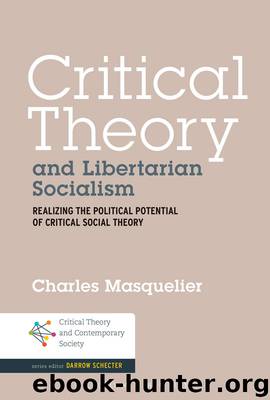
Author:Charles Masquelier [Masquelier, Charles]
Language: eng
Format: epub
Tags: Philosophy, Political, History & Theory, General, Political Science, Essays
ISBN: 9781441175700
Google: e3LHAgAAQBAJ
Publisher: Bloomsbury Publishing USA
Published: 2014-01-02T21:16:14+00:00
6
Drawing the contours of institutionalized emancipatory practice
Frankfurt school critical theorists, with the possible exception of Habermas, have refrained from exploring the institutional arrangement potentially capable of yielding emancipatory practices. The reason for this can be found in their conceptualization of critical theory’s task as a primarily diagnostic one. Critical theory, they argued, can only be expected to negate the existing world by revealing the ‘separation between individual and society’ (Horkheimer 1975, 207). However, as I sought to demonstrate in Chapter 3, the principle of dialectical negation, in virtue of its opposition to the status quo, necessarily entails considerations and anticipations regarding what the status quo is not. Although some prescriptive recommendations can be found in the work of first-generation critical theorists,1 it was suggested in Chapter 3 that critical theory should fulfil its own, at times unacknowledged, promises and realize the full scope of dialectical negation in such a way as to provide an insight into alternative objective conditions of existence. In this chapter, I shall attempt to accomplish the aforementioned goal by revealing the affinity between Marx’s work, the critique of advanced capitalism formulated by first-generation Frankfurt School thinkers and the libertarian socialism of G.D.H. Cole.
Democracy and the reconciliation of humanity and nature
Habermas was the first member of the Frankfurt School to engage in a theoretical exercise partly aimed at drawing the contours of the democratic processes through which individuals could be expected to find the practical means for the emancipation of their internal nature from the repressive mechanisms of advanced capitalism. One could indeed discover, in his work, a significant concern with the institutional arrangement making such a form of emancipation possible as early as The Structural Transformation of the Public Sphere (1989). At the core of his critical theory is the notion of control intimately connected with his approach to moral autonomy and democracy:
We shall understand democracy to mean the institutionally secured forms of general and public communication that deal with the practical question of how men can and want to live under the objective conditions of their ever-expanding power of control. (1971, 57)
In accordance with his differentiation of the two logics of emancipation discussed in Chapter 4, Habermas wishes to present the issue of democratic control and the decisions regarding the common good as questions of a practical rather than a technical nature. Since actions involved in the efficient mastery of external nature are guided by knowledge interests of a different kind from those involved in decisions regarding ‘how men can and want to live’, communicative channels oriented towards the latter can only be expected to find their institutional forms alongside economic and technological development, rather than within the subject–object relations framing the so-called technical mastery of external nature.
Habermas, however, did not seek to remove technical matters entirely from decision-making processes. He in fact suggested that the problem facing individuals in advanced capitalist societies ‘can […] be stated as one of the relation between technology and democracy: how can the power of technical control be brought within the range of the consensus of acting and transacting citizens’ (Habermas 1971, 57).
Download
This site does not store any files on its server. We only index and link to content provided by other sites. Please contact the content providers to delete copyright contents if any and email us, we'll remove relevant links or contents immediately.
| Anthropology | Archaeology |
| Philosophy | Politics & Government |
| Social Sciences | Sociology |
| Women's Studies |
The Secret History by Donna Tartt(19092)
The Social Justice Warrior Handbook by Lisa De Pasquale(12190)
Thirteen Reasons Why by Jay Asher(8912)
This Is How You Lose Her by Junot Diaz(6888)
Weapons of Math Destruction by Cathy O'Neil(6281)
Zero to One by Peter Thiel(5802)
Beartown by Fredrik Backman(5756)
The Myth of the Strong Leader by Archie Brown(5509)
The Fire Next Time by James Baldwin(5447)
How Democracies Die by Steven Levitsky & Daniel Ziblatt(5219)
Promise Me, Dad by Joe Biden(5154)
Stone's Rules by Roger Stone(5088)
A Higher Loyalty: Truth, Lies, and Leadership by James Comey(4964)
100 Deadly Skills by Clint Emerson(4926)
Rise and Kill First by Ronen Bergman(4790)
Secrecy World by Jake Bernstein(4753)
The David Icke Guide to the Global Conspiracy (and how to end it) by David Icke(4720)
The Farm by Tom Rob Smith(4514)
The Doomsday Machine by Daniel Ellsberg(4490)
